
Prompt
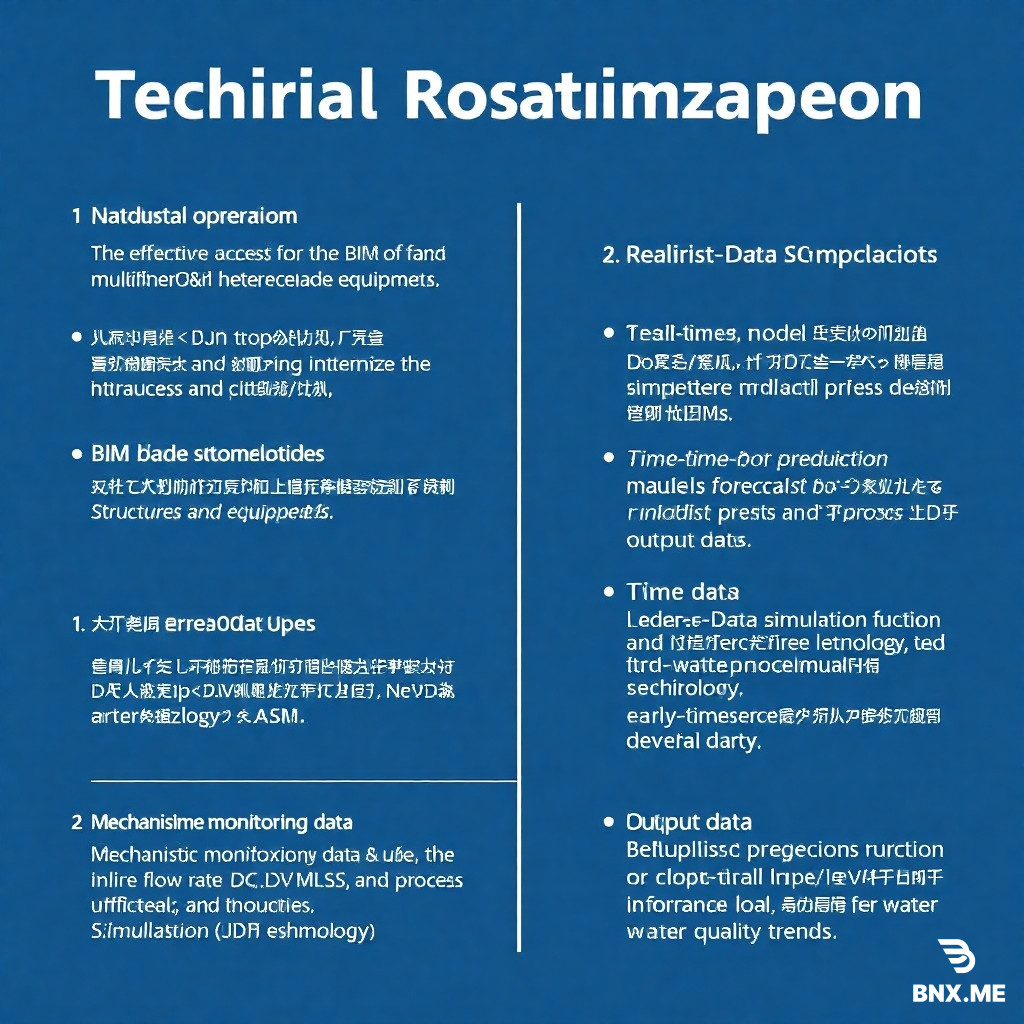
English Translation (for Technical Roadmap) 1. Unified Access and Fusion of Multi-source Heterogeneous Data The effective operation of the intelligent O&M platform depends on the unified access and fusion of multi-source heterogeneous data. To meet the platform's data requirements, an access scheme covering the following four data categories is proposed: (1) BIM model data, encompassing 3D geometric information, spatial topological relationships, and static attribute parameters of structures and equipment; (2) Real-time monitoring data (with reserved interfaces), covering online indicators such as flow rate, DO, MLSS, pH, temperature, and influent/effluent quality across all process units; (3) Mechanistic model computational data, i.e., the simulated values of state variables and process simulation results derived from the ASM; and (4) Time-series prediction model output data, including lead-time forecasts of influent load and early-warning information on water quality trends. 2. Mechanism-Data Synergy-Driven Dynamic Process Simulation Technology Building upon the previous research component, this module develops a dynamic process simulation function to establish a closed-loop real-time linkage of "Monitoring–Simulation–Prediction". Real-time monitoring data serve as initial conditions and boundary inputs to drive the ASM for online simulation, generating simulated values of state variables for each unit and real-time predictions of effluent quality. The platform also allows O&M personnel to manually set different operating conditions to drive scenario-based simulations, thereby assessing system responses and effluent quality trends under various control measures. Furthermore, by feeding the lead-time forecasts of influent load from the time-series prediction model into the ASM, the system can pre-evaluate the evolution of system states and effluent compliance risks 2 to 8 hours in advance. When predicted indicators are about to exceed preset thresholds, the platform automatically triggers alerts and highlights the relevant process units in the 3D model, providing operators with sufficient lead time for regulation and response. 3. Mechanism-Data Synergy-Driven Intelligent Decision Support and Carbon Emission Management Centered on the "mechanism-data synergy-driven" paradigm, this module investigates intelligent decision support and automated carbon emission accounting methods at the platform level. The intelligent decision support system comprises three sub-modules: Comprehensive Operational Status Assessment Module: Based on the key state variables and process parameters output by the ASM, a multi-dimensional evaluation index system is constructed, covering treatment efficiency, operational stability, energy consumption, and equipment health conditions, enabling quantitative assessment and graded visualization of the current operational status. Abnormal Diagnosis and Traceability Module: When effluent quality anomalies or operational deviations are detected, the module leverages the causal reasoning capability of the ASM mechanistic model, combined with real-time monitoring data and historical case bases, to rapidly diagnose and trace the root causes. For instance, in the event of excessive total nitrogen in the effluent, backward inference via the model can determine whether it is attributable to insufficient influent carbon sources, low internal recirculation ratios, or insufficient HRT in the anoxic zone, thereby providing O&M personnel with clear directions for troubleshooting. Control Strategy Recommendation Module: The optimal control parameter combinations obtained from multi-objective optimization are embedded into the platform in the form of knowledge rules or lookup tables. When system operating conditions change or early-warning signals are received, the platform automatically retrieves and matches the recommended control strategies for the current working conditions (e.g., DO setpoint adjustments, carbon source dosage corrections, etc.) and delivers them to O&M personnel as textual prompts or visual annotations for reference.
Engine
BNX AI 1.0
Size
1:1
Created
28 June, 2026
Views
5
Downloads
1
Share
HTML Code
This is just one of the features of our unique system. Our model works very quickly and accurately. It uses advanced artificial intelligence and creates high-quality images.

ㅤBNX AI algorithms run on proprietary clusters built on NVIDIA GB300 NVL72 systems.

ㅤGeneration of images with any aspect ratio: 1:1, 2:3, 3:2, 4:5, 5:4, 4:3, 3:4, 16:9, 21:9, 9:16, 9:21

ㅤThere is nothing superfluous in our interface, only a prompt input field.

Our prices are on average 83% cheaper than those of large AI companies.

Even on the free plan, you can download generated images without restrictions.

Our own algorithm. Fast, modern. Almost perfect. Developed over 2 years.
Answers to frequently asked questions about working with the BNX AI 1.0 image generation system.
We are a young, technology-driven, growing startup. At the moment, we are not attracting funding from venture capital funds or business angels, so we would appreciate any support. You can sign up for the Enterprise plan, which will help us. 💙

When generating an image, you can open the options and enable stealth mode, then the images will not be added to the public database and no one will see them; they will be private.
We trained the BNX AI 1.0 algorithm for over a year, and it is equally adept at generating various types of images: illustrations, architecture, portraits, super-realistic images, 3D models, logos, and much more. We managed to achieve very good results when working with text, so it is easy to create both a logo and a poster.
You may use the images at your discretion. Professional and Enterprise plan users may use the images for any commercial purposes. They may also sell these images. We ask Standard plan users to include a link to bnx.me when publishing images, but this is not a mandatory requirement.