
Prompt
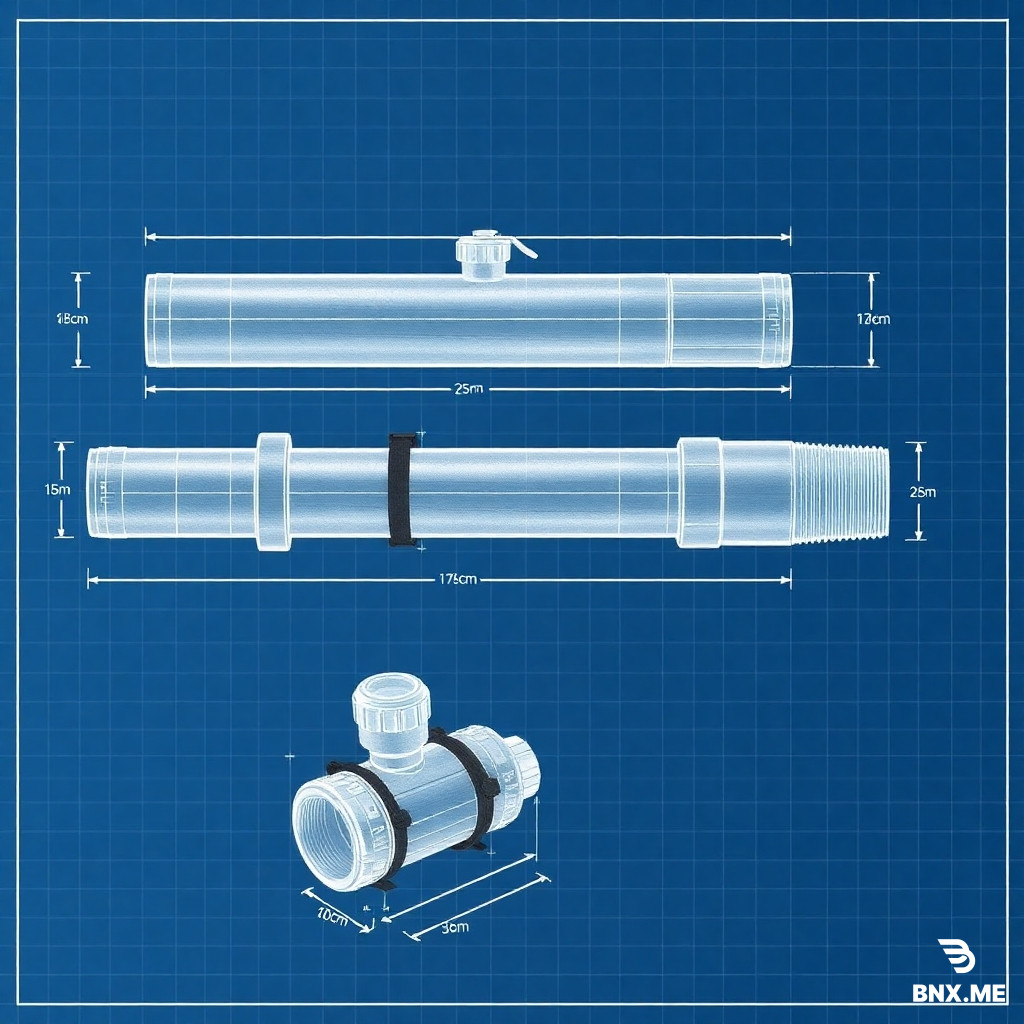
A highly detailed technical blueprint-style engineering drawing of a homemade water blaster toy. White crisp lines on a dark blue grid background with precise measurements. The drawing features both a side view and an isometric 3D view showing all dimensions and measurements clearly marked. The main structure consists of two galvanized steel pipes: a primary pressure chamber pipe measuring exactly 25cm in length with a 27mm outer diameter and 2mm wall thickness, and a secondary support pipe measuring 17.3cm in length with the same 27mm diameter and 3mm wall thickness. These two pipes are positioned parallel to each other with the smaller pipe zip-tied underneath the main pipe using black plastic zip-ties (tiewraps) spaced evenly along the length. The smaller pipe serves as a shoulder stock for stable two-handed aiming. At the front end of the main pipe, a brass ball valve (kogelkraan) with a 1/2 inch (15mm) thread is attached as the water release mechanism. The ball valve has a lever handle clearly shown in the open position. Attached to the outlet of the ball valve is a plastic bottle cap nozzle with a precisely drilled 2.6mm hole in its center, shown in cross-section to reveal the clean hole geometry. This nozzle creates a thick, soaking water stream when fired. A clear flexible aquarium hose with 6mm inner diameter runs from the rear end of the main pipe, passing through a sealed wooden dowel plug, and extends downward to connect to a standard 2-liter cola bottle. The cola bottle serves as the water reservoir and is shown in detail with its screw cap modified to accept the hose. The hose reaches all the way to the bottom of the cola bottle to draw water effectively. A binder clip is shown clamped onto the hose midway between the cola bottle and the main pipe, functioning as a shut-off valve. This clip is shown in both the open and closed positions. A Schrader valve (bicycle tire valve) is visible on the rear end of the main pipe, protruding through the same wooden dowel plug. The Schrader valve is shown with its threaded exterior and internal spring-loaded pin. A bicycle pump is shown attached to the Schrader valve in a separate callout detail. The wooden dowel plugs at both ends of the main pipe are shown in cross-section with detailed callouts showing the two holes drilled through the rear plug (one 6mm for the hose, one 8mm for the Schrader valve) and one 6mm hole through the front plug for the nozzle hose. Two M4 safety bolts are shown locking both wooden plugs in place, drilled through the metal pipe wall 1cm from each end. These bolts physically block the plugs from ejecting under high pressure. The bolts and nuts are shown with dimensions. All parts are clearly labeled with professional callout lines and text in a clean sans-serif font. Dimensions are shown in both millimeters and centimeters: 25cm main pipe, 17.3cm stock pipe, 27mm outer diameter, 2.6mm nozzle hole, 6mm hose diameter. Each component has a numbered label corresponding to a parts list in the corner of the blueprint. Additional detailed callout boxes show: - A cross-section of the rear plug showing the hose and Schrader valve positions - A cross-section of the front plug showing the nozzle hose - A detailed view of the ball valve mechanism - A detailed view of the binder clip clamp system - A detailed view of the cola bottle cap modification The blueprint includes measurement arrows, dimension lines, angle indicators, and material callouts (galvanized steel, brass, plastic, rubber, wood). Assembly notes and torque specifications are shown in small text. The drawing has a professional engineering aesthetic with precise mechanical drafting style, grid lines at 1cm intervals, and a title block in the bottom right corner reading "HOMEMADE WATER BLASTER - TECHNICAL BLUEPRINT - SIDE VIEW WITH DIMENSIONS" with a date and scale notation. Architectural blueprint style, white lines on dark blue background, highly detailed mechanical drawing, professional engineering diagram, crisp technical illustration, exact measurements and tolerances, photorealistic blueprint rendering, sharp focus, studio quality, publication ready.
Engine
BNX AI 1.0
Size
1:1
Created
23 June, 2026
Views
15
Downloads
1
Share
HTML Code
This is just one of the features of our unique system. Our model works very quickly and accurately. It uses advanced artificial intelligence and creates high-quality images.

ㅤBNX AI algorithms run on proprietary clusters built on NVIDIA GB300 NVL72 systems.

ㅤGeneration of images with any aspect ratio: 1:1, 2:3, 3:2, 4:5, 5:4, 4:3, 3:4, 16:9, 21:9, 9:16, 9:21

ㅤThere is nothing superfluous in our interface, only a prompt input field.

Our prices are on average 83% cheaper than those of large AI companies.

Even on the free plan, you can download generated images without restrictions.

Our own algorithm. Fast, modern. Almost perfect. Developed over 2 years.
Answers to frequently asked questions about working with the BNX AI 1.0 image generation system.
We are a young, technology-driven, growing startup. At the moment, we are not attracting funding from venture capital funds or business angels, so we would appreciate any support. You can sign up for the Enterprise plan, which will help us. 💙

When generating an image, you can open the options and enable stealth mode, then the images will not be added to the public database and no one will see them; they will be private.
We trained the BNX AI 1.0 algorithm for over a year, and it is equally adept at generating various types of images: illustrations, architecture, portraits, super-realistic images, 3D models, logos, and much more. We managed to achieve very good results when working with text, so it is easy to create both a logo and a poster.
You may use the images at your discretion. Professional and Enterprise plan users may use the images for any commercial purposes. They may also sell these images. We ask Standard plan users to include a link to bnx.me when publishing images, but this is not a mandatory requirement.