
Prompt
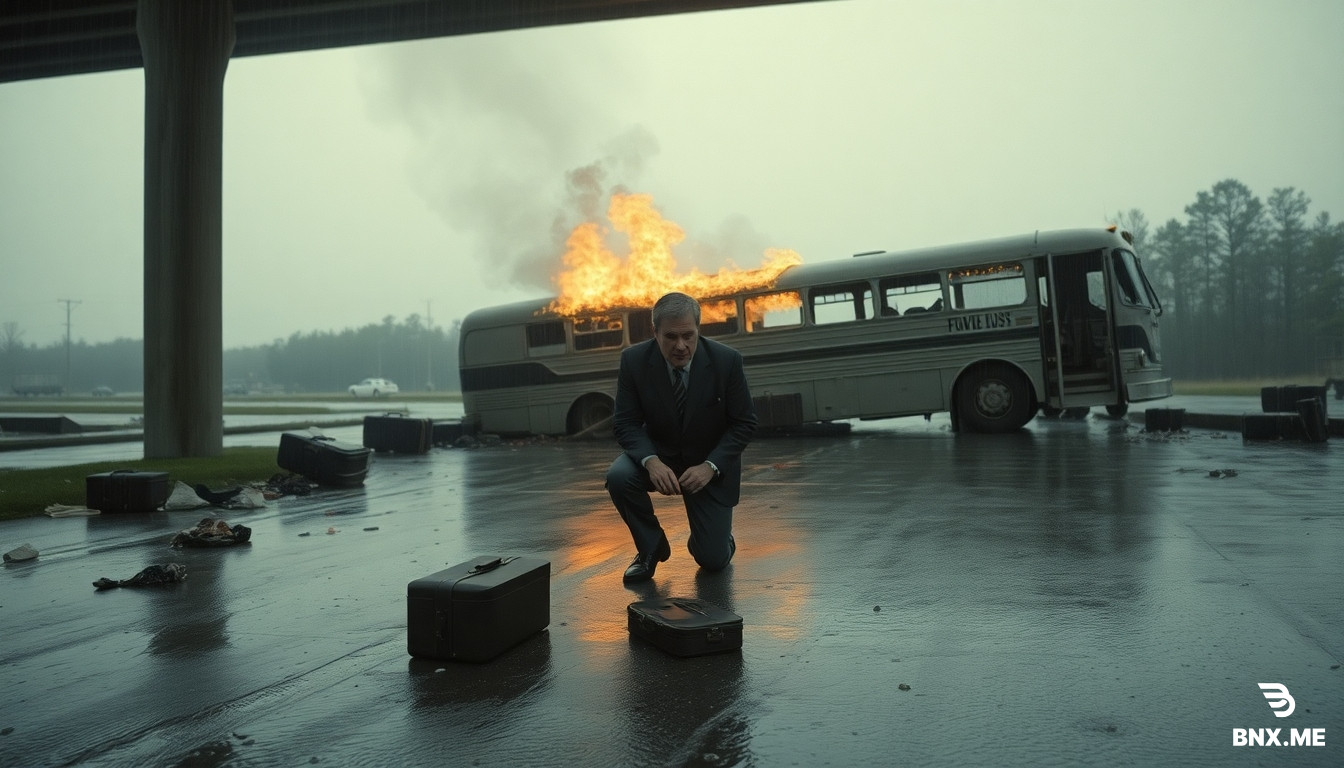
A desolate, rain-soaked highway underpass in Alabama, 1956. The scene is one of utter devastation—a Greyhound bus lies broken and shattered against a bridge abutment, its two halves spun apart, one section engulfed in flames that hiss and sputter against the relentless rain. The asphalt is slick with water, scattered with the debris of disaster: suitcases burst open, clothing strewn across the pavement, personal effects crushed and broken. The air is thick with smoke, the smell of burning diesel, and the metallic tang of blood. The scene captures the moment of Paul Edgecombe's greatest loss—and the terrible truth he will carry for the rest of his life. In the center foreground, PAUL EDGECOMBE (64 years old, Caucasian, Tom Hanks-type aged with gray hair and deeper lines, kind weary eyes now shattered with grief, wearing a 1950s-style suit jacket and slacks, soaked through with rain) kneels on the wet pavement, his body hunched over the form of his wife. His hands are outstretched, one resting on her shoulder, the other hovering near her face. His expression is one of raw, unbearable anguish—his mouth open in a silent scream, his eyes wide with horror and disbelief. Rain streams down his face, mingling with his tears. His suit is soaked, his hair plastered to his skull. He has just screamed for help, and no one has come. On the pavement before him lies JANICE EDGECOMBE (59 years old, Caucasian, Bonnie Hunt-type aged gracefully, warm kind face now slack and lifeless, dark hair streaked with gray and matted with blood, wearing a red dress—her second-best, saved for graduation) in a crumpled heap. Her body trembles with the last shivers of life, one shoe missing, her foot jittering. Her eyes are open but blank, the left one full of blood. The back of her head is crushed, blood pouring from the wound, pooling on the wet pavement. Beside her trembling hand lies a piece of chromed steel reading "GREY," and part of what had once been a businessman in a brown suit. Rain continues to fall on her still form, the droplets mixing with the blood and spreading in dark rivulets. In the background, partially visible in the shadows of the underpass, a massive, shadowy figure stands—JOHN COFFEY (vision/apparition, African American, massive 6'6"–6'8" build, Michael Clarke Duncan-type, broad expressive face now a shadow of itself, large sad eyes watching with silent sorrow, very short dark close-cropped hair, wearing what appears to be a prison-issue denim uniform, barefoot) is barely visible in the darkness beneath the bridge. He is a silhouette, a ghostly presence—rain on his face mixing with his endless tears. His arms hang loose at his sides, his body still and watching. He is there, and then he is gone—a trick of the eye, or something more. The shadows swallow him, leaving only the suggestion of his presence. The wreckage surrounds them: the twisted metal of the bus, the shattered windows, the scattered suitcases and personal effects. A boy of about thirteen lies dead nearby, his P.F. Flyers visible, half his face gone. A severed hand with a garnet ring lies on the pavement. A bloody teddy bear, a pair of shattered glasses, an alarm clock—all the debris of lives abruptly ended. The fertilizer truck that broadsided them lies overturned nearby, its cargo spilling across the asphalt. The rain falls in sheets, relentless and unforgiving, beating down on the scene of devastation. The burning diesel hisses and spits, casting an orange glow on the wet pavement. The composition is vast and devastating: Paul and Janice dominate the foreground, their tragedy centered in the frame. The wreckage stretches out behind them, a landscape of loss. The underpass looms in the background, its shadows suggesting the presence of John Coffey, a silent witness to the cruelty of fate. The rain creates a curtain of water, blurring the edges of the scene and emphasizing the isolation of the moment. The burning bus casts an orange glow on the scene, contrasting with the gray of the rain and the dark of the asphalt. Every element speaks of loss and the terrible randomness of fate: the shattered bus, the scattered belongings, the dead boy, the severed hand, the burning diesel, and the vision of John Coffey in the shadows—a reminder of the miracle that saved Paul, but could not save his wife. The atmosphere is one of profound despair—Paul has been spared, but at the cost of everything he loved. In the transition, the visual should flow naturally to the next moment: Janice dies in Paul's arms—no final awareness, no whispered declaration, just a shivery clench in her flesh, and she is gone. Paul puts his wife's mangled head down on the wet pavement and stands easily, only a small cut on his left hand. He screams John's name into the underpass, asking where he is. He walks toward the shadows, kicking aside the debris, demanding to know why John saved Hal's wife but not his. No answer comes—only burning diesel and burning bodies, only rain falling ceaselessly on the cement, his wife dead on the road behind him. Standing in that Alabama rain, amid the spilled luggage and the ruined dead, looking for a man who wasn't there, Paul learns a terrible truth: sometimes there is absolutely no difference at all between salvation and damnation. The vision of John Coffey fades, and Paul is left alone with his grief. PERIOD AUTHENTICITY NOTES: 1956 era Greyhound bus (vintage model with chrome trim) 1950s-style clothing: Paul's suit jacket and slacks, Janice's red dress Period-appropriate debris: P.F. Flyers sneakers, alarm clock, suitcases, personal effects 1950s-era fertilizer truck Alabama highway and underpass (period infrastructure) Rain and storm conditions consistent with 1950s weather depiction Burning diesel fire period-appropriate Chromed steel lettering ("GREY") consistent with Greyhound bus branding CINEMATIC INDIRECT DEPICTION NOTES: The bus crash and its victims are shown through aftermath and debris, not through graphic depiction of the accident Janice's injuries are suggested through blood and her still form, not through explicit gore The vision of John Coffey is shown as a shadowy, ghostly presence, partially obscured by darkness and rain The devastation is conveyed through the scattered debris—suitcases, personal effects, the dead boy partially visible Paul's grief is shown through posture, tears, and his silent scream, not through exaggerated emotional expression The "salvation and damnation" theme is conveyed through composition—the burning bus and the rain, the shadow of John Coffey and the body of Janice The weight of the moment is conveyed through the vastness of the landscape and the isolation of the figures within it The transition from the vision to reality is suggested through the fading of John's presence into the shadows
Engine
BNX AI 1.0
Size
16:9
Art Style
Cinematic
Created
20 June, 2026
Views
6
Downloads
0
Share
HTML Code
This is just one of the features of our unique system. Our model works very quickly and accurately. It uses advanced artificial intelligence and creates high-quality images.

ㅤBNX AI algorithms run on proprietary clusters built on NVIDIA GB300 NVL72 systems.

ㅤGeneration of images with any aspect ratio: 1:1, 2:3, 3:2, 4:5, 5:4, 4:3, 3:4, 16:9, 21:9, 9:16, 9:21

ㅤThere is nothing superfluous in our interface, only a prompt input field.

Our prices are on average 83% cheaper than those of large AI companies.

Even on the free plan, you can download generated images without restrictions.

Our own algorithm. Fast, modern. Almost perfect. Developed over 2 years.
Answers to frequently asked questions about working with the BNX AI 1.0 image generation system.
We are a young, technology-driven, growing startup. At the moment, we are not attracting funding from venture capital funds or business angels, so we would appreciate any support. You can sign up for the Enterprise plan, which will help us. 💙

When generating an image, you can open the options and enable stealth mode, then the images will not be added to the public database and no one will see them; they will be private.
We trained the BNX AI 1.0 algorithm for over a year, and it is equally adept at generating various types of images: illustrations, architecture, portraits, super-realistic images, 3D models, logos, and much more. We managed to achieve very good results when working with text, so it is easy to create both a logo and a poster.
You may use the images at your discretion. Professional and Enterprise plan users may use the images for any commercial purposes. They may also sell these images. We ask Standard plan users to include a link to bnx.me when publishing images, but this is not a mandatory requirement.